A framework for designing experiences that actually change people.
Five stages. One coherent arc. Grounded in 20+ years of research in experience psychology - and tested in the real world with organizations across four continents.
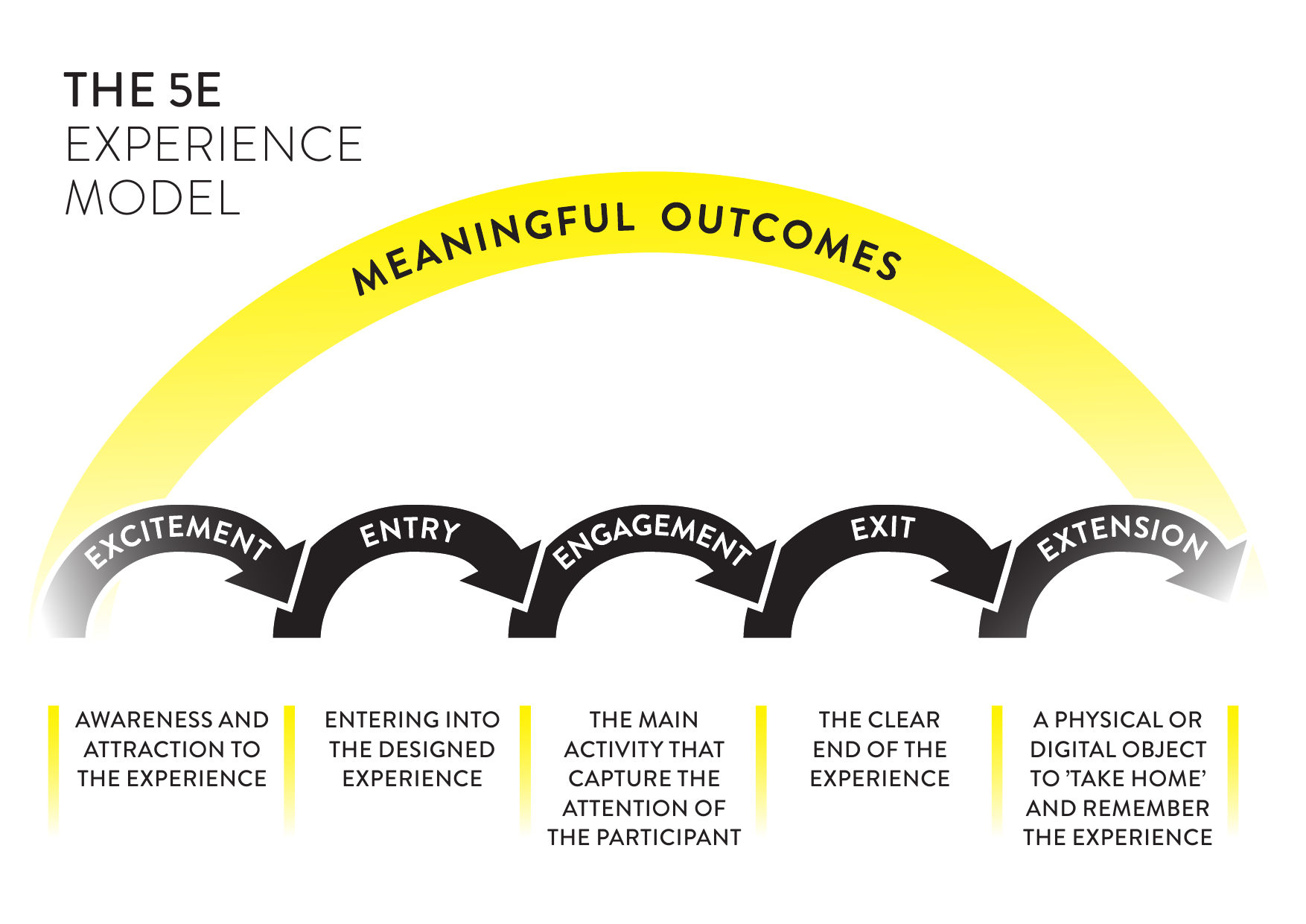
Most experiences are designed from the middle out. The 5E model fixes that.
The majority of experience design - workshops, training programs, onboarding, events, even retail - focuses almost entirely on the Engagement stage: what happens in the room, what's on the agenda, what people will do. The before and after are treated as logistics, not design. The opening and closing are afterthoughts.
This is a problem, because the evidence is clear: people don't remember experiences the way they happen. They remember how they felt at the peak and how it ended. They remember what they expected before they arrived and whether those expectations were honored. They remember what they did with it after.
The 5E Experience Design Model is a framework I developed over 20 years of practice - teaching at Kaospilot, running programs for global organizations, and researching how experiences actually form in memory. It names and designs all five moments: Excitement, Entry, Engagement, Exit, Extension.
It's not a funnel. It's a memory architecture - a way of designing the full arc of an experience so that what you intend to happen actually happens to people.
Excitement
Draw people in before they arrive.
The experience begins before it begins. The moment someone learns your event exists - the invitation, the description, the recommendation from a colleague - is already part of the experience. Most designers ignore this entirely.
Excitement is about creating anticipation. Not just awareness or information, but a felt sense of curiosity - an information gap that makes someone want to close it. Done well, it creates a kind of pre-commitment: people arrive already invested, already open.
The research on this is striking. Studies by Nowlis, Mandel, and Ariely (2004) showed that people who anticipate an experience with curiosity enjoy it measurably more - and rate it higher in retrospect - than people who simply signed up and showed up. Anticipation is not a preamble to the experience. It is part of the experience.
In practice, Excitement is about what you communicate, how, and what you deliberately leave unsaid. It's the workshop description that opens a question rather than closes it. It's the pre-read that makes someone think. It's the moment someone tells a colleague about it and gets intrigued.
✦ Psychology: Loewenstein's information-gap theory (1994)- What single question will make them curious enough to say yes?
- What do you leave unsaid - and why?
- What does a great invitation to this experience feel like?
- What do people tell others when they recommend it?
- How do you honor the expectation you set?
- A workshop description that poses a question, not a syllabus
- A pre-read or artifact that activates thinking before arrival
- A personal invitation rather than a calendar invite
- A teaser that creates positive uncertainty
Entry
Welcome & orient at the threshold.
The first minutes of any experience carry disproportionate weight. People arrive with noise in their heads - the meeting they just left, the email they didn't send, the train that was late. They also arrive with expectations you set during Excitement. The Entry stage is about honoring both.
Entry is the threshold moment. It's how you help someone cross from their previous context into this one. It's how you set the frame for what's about to happen - not through explanation, but through experience. The space, the welcome, the first activity all communicate what kind of place this is and what kind of participation is wanted.
The primacy effect (Murdock 1962) is well-established: first impressions form durable schemas that are resistant to updating. What happens in the first 15 minutes shapes how people interpret everything that follows. An awkward Entry creates doubt. A strong Entry creates permission.
In practical terms, Entry means designing the room people walk into, the words that greet them, and the first thing they do - not as logistics but as design choices that set the experience in motion.
✦ Psychology: Primacy effect (Murdock 1962)- What does the first minute feel like when someone arrives?
- What state do you want people in before the core begins?
- What does the space communicate before anyone speaks?
- What's the first thing people do - and what does that signal?
- How do you help people let go of what came before?
- A deliberate welcome that acknowledges people's whole selves
- An opening activity that signals participation, not performance
- A physical environment that matches the experience's intention
- A frame-setting moment that answers "why are we here?"
Engagement
The core experience - substance and challenge.
Engagement is what most designers spend all their time on - and they're right that it matters. This is where the actual learning, making, connecting, or transforming happens. It's the heart of the experience. But designed in isolation from the other four stages, it's never as powerful as it could be.
The key design principle in Engagement is challenge-skill balance. Csikszentmihalyi's flow research (1990) found that optimal experience - the state people describe as being fully alive and present - occurs when the challenge of a task precisely meets the skill of the person attempting it. Too easy: boredom. Too hard: anxiety. Just right: flow.
This means Engagement isn't just about content delivery. It's about calibrating demand - designing activities that stretch people without breaking them, that require real participation rather than passive receiving. The best Engagement experiences feel like work in the best sense: effort that produces something real.
Kolb's experiential learning cycle (1984) is also at work here: people learn through doing, then reflecting, then conceptualizing, then applying. The Engagement stage should move through all four - not just the doing.
✦ Psychology: Flow theory (Csikszentmihalyi 1990) · Kolb's experiential learning cycle (1984)- What's the right level of challenge for this group?
- When do people reflect - not just do?
- What produces a real output, not just an insight?
- Where does it get genuinely hard - and is that intentional?
- What happens when someone gets stuck?
- Activities with real stakes and real outputs
- Built-in reflection moments (not just debrief at the end)
- Challenge scaled to the group's starting point
- Peer learning that uses the room's expertise
Exit
Close with intention so the ending lands.
Most experiences end badly. There's a great day, a strong morning, a powerful workshop - and then it sort of runs out of time and everyone goes home. The closing is treated as the residue after the real work is done. This is one of the most costly design mistakes you can make.
Kahneman and Fredrickson's peak-end rule (1993) is one of the most robust findings in experience psychology: people don't evaluate experiences by averaging all the moments. They evaluate them almost entirely by two points - the peak moment of intensity and the ending. A weak Exit can erase a strong Engagement. An intentional Exit can make a good experience great.
Exit isn't just about closing rituals or nice goodbyes. It's about integration - giving people a moment to bring what happened into language, into relationship, into a decision about what comes next. The Exit is where the experience becomes a story people carry and tell.
In practice: design the last 20 minutes as carefully as the first 20. What is the final act? What do people leave with - physically and emotionally? What's the last thing they hear? What question do they leave with?
✦ Psychology: Peak-end rule (Kahneman & Fredrickson 1993)- What do you want people to feel in the last five minutes?
- What's the single thing people should leave knowing?
- What do they physically take with them?
- What question do they leave open?
- How does the closing honor what just happened?
- A closing ritual that names what happened
- Time for individual integration (not just group debrief)
- A physical artifact or note people take with them
- A clear bridge from this experience to what's next
Extension
Keep learning alive after the experience ends.
Herman Ebbinghaus mapped the forgetting curve in 1885: without deliberate re-activation, humans forget approximately 70% of new information within 24 hours, and around 90% within a week. This means the most brilliantly designed Engagement stage is losing most of its impact before people get home.
Extension is how you fight the forgetting curve. It's the design of what happens after - the follow-up email that's a prompt, not a thank-you, the community that continues the conversation, the practice that applies the learning, the check-in that surfaces what stuck.
The Zeigarnik effect (1927) suggests that incomplete things stay more present in memory than complete ones. A well-designed Exit leaves an open question; a well-designed Extension answers it through practice. Together they create a loop that keeps the experience alive and working long after it ends.
In organizational contexts, this is often where the real ROI lives. A one-day workshop that Extends well changes behavior. One that doesn't is a nice memory by Friday.
✦ Psychology: Ebbinghaus forgetting curve (1885) · Zeigarnik effect (1927)- What's the first touchpoint after it ends - and when?
- What community or connection continues the conversation?
- What practice makes the learning stick?
- What would participants do differently Monday morning?
- How do you know if transfer happened?
- A 24-hour follow-up prompt (not a thank-you email)
- A 2-week check-in or practice challenge
- A shared space where application continues
- A peer accountability structure
"I can honestly say this has been one of the most impactful trainings I have ever experienced. I was not only learning with my mind but felt what I was learning throughout. There was so much attention to detail and moments of surprise."Lena Sievers · Cultural Transformation Manager
The five stages are not a checklist. They're a coherent arc.
Each stage prepares the ground for the next. Excitement creates investment that makes Entry easier. Entry creates permission that makes Engagement deeper. Engagement creates material that makes Exit meaningful. Exit creates a story that makes Extension possible.
Skip any stage and you feel it. Skip Excitement and people arrive cold. Skip Entry and they never quite land. Skip Exit and the energy dissipates. Skip Extension and the forgetting curve wins. Design all five and you have something rare: an experience people carry forward, apply, and remember.
The model works across industries. A product onboarding flow. A leadership retreat. A retail experience. An online course. A medical consultation. The stages are always present - the only question is whether you design them intentionally or leave them to chance.
Five industries. Same framework. Different expressions.
The 5E stages show up in every experience context. What changes is how you activate each one. Here are five domains where practitioners use the model:
| Context | Excitement | Entry | Engagement | Exit | Extension |
|---|---|---|---|---|---|
| Workshop / Training | Curiosity-first invitation | Opening ritual | Hands-on challenge | Closing ceremony | Follow-up practice |
| Product Onboarding | Trial or demo tease | Personalized welcome | First value moment | "You're set up" moment | Tips, community, milestones |
| Retail / Service | Window display, social | Greeting, environment | Product interaction | Packaging, farewell | Loyalty, follow-up |
| Leadership Program | Pre-read with a real question | Peer introductions | Live leadership challenge | Personal commitment | Cohort, coaching |
| Online Course | Trailer or preview lesson | Orientation lesson | Active assignments | Completion milestone | Alumni community |
How the 5E Experience Design Model relates to other frameworks.
Practitioners often ask how the 5E model relates to design thinking, customer journey maps, or other "5E" models. Here's a brief orientation:
| Framework | Developed by | Primary focus | Relationship to 5E |
|---|---|---|---|
| 5E Experience Design Model | Andy Sontag | Designing the full arc of any experience for human impact | This framework |
| Bybee's 5E Instructional Model | Roger Bybee, 1987 | Science education lesson planning (Engage, Explore, Explain, Elaborate, Evaluate) | Different model, different domain. Same count, different intent. |
| Customer Journey Map | Various (popularized by IDEO) | Mapping existing customer touchpoints | Complementary. A CJM describes what is; 5E designs what should be. |
| Design Thinking | Popularized by IDEO / d.school | Problem-solving process (Empathize, Define, Ideate, Prototype, Test) | Use design thinking to understand your audience; use 5E to design the experience for them. |
| ADDIE Model | US Army, 1975 | Instructional design (Analyze, Design, Develop, Implement, Evaluate) | ADDIE is a development process; 5E is a participant experience arc. They operate at different levels. |
The model has been used in programs at Google, IKEA, LEGO, Adidas, Netflix, the UN, and 25+ other organizations.
"This course equipped me with a toolkit for navigating emotions and creating meaningful, impactful experiences - to open up my clients' hearts and minds to change."
"Helped our teams gain a different perspective on what it means to design meaningful experiences. What is it that matters? How does it feel? What does it change?"
"The first time something I learned in Andy's program followed me into the rest of my week, I knew something real had happened."
Questions about the 5E model.
What is the 5E Experience Design Model?
The 5E Experience Design Model is a framework for designing experiences that produce real, lasting change. Created by Andy Sontag, it maps five stages in the arc of any experience: Excitement (draw people in before they arrive), Entry (welcome and orient at the threshold), Engagement (the core experience - substance and challenge), Exit (close with intention so the ending lands), and Extension (keep learning alive after it ends). Each stage is grounded in a specific body of experience psychology research.
Who created the 5E Experience Design Model?
The 5E Experience Design Model was created by Andy Sontag, an experience designer based in Copenhagen. Sontag developed the model over 20+ years of research and practice, and teaches it as the central framework of the Kaospilot Experience Design program. The model has been applied in programs for Google, Netflix, IKEA, LEGO, Adidas, Volkswagen, the UN, Oracle, Novonesis, and dozens of other organizations globally.
Is this the same as Bybee's 5E Instructional Model?
No. Bybee's 5E Instructional Model (1987) is a science education framework with stages: Engage, Explore, Explain, Elaborate, Evaluate. Andy Sontag's 5E Experience Design Model is a distinct framework with different stages (Excitement, Entry, Engagement, Exit, Extension) addressing a different problem: how to design any experience - workshop, training, event, onboarding, retail - that produces genuine change in people. The two models share a name structure but serve different purposes for different audiences.
Can I use the 5E model for online experiences?
Yes. All five stages apply in digital contexts, though they express differently. Excitement might be a teaser email or preview lesson. Entry might be an orientation video and personalized welcome. Engagement is the active work - assignments, discussions, challenges. Exit might be a completion milestone or reflection prompt. Extension is the alumni community, follow-up practice, or accountability structures that keep learning alive after the course ends.
Where can I find the free 5E Miro template?
A free Miro template for the 5E Experience Design Model is available on Andy Sontag's website. It provides a visual canvas for mapping all five stages of your experience design, with design prompts for each stage.
How long does it take to design using the 5E model?
The 5E model is a design lens, not a process with fixed timing. A solo designer working on a simple workshop can run through all five stages in a few hours using the Miro template. A team designing a multi-day leadership program might spend days in each stage. The model scales to the complexity of the experience.
Ready to design with the 5E model?
Get the free Miro template - or work directly with me to design your next experience.